
CALL OR TEXT US NOW
630-426-0196

Reasons to Challenge a Loved One’s Will
 In the days and weeks after the death of a loved one, you are likely to remain focused on getting back some semblance of normalcy in your life, especially if you were very close to the person who passed away. Just as things start to settle back down emotionally, new concerns can arise when your loved one’s will is presented for probate. When the provisions in the will are finally made known, you may be surprised to learn that your loved one had made some unexpected decisions. Such surprises may lead you to think about filing a will contest, but there are factors to consider before you do so.
At A. Traub & Associates, we know how difficult it can be to review a will while processing a loved one’s death. With over 150 5-star reviews, our Lombard, IL estate administration attorneys have built a reputation for caring advocacy.
Hurt Feelings Don’t Invalidate a Will
The first thing you need to remember is that, following a person’s death, there will almost always be someone who feels that they got ignored, left out, or the short end of the stick. They may have been led to expect a certain portion of the inheritance or a particular piece of property, only to find out later that such "promises" were never formalized in the will. If you feel slighted by your loved one’s decisions regarding his or her will, that is not sufficient grounds for challenging the document.
Who Can Contest a Will?
In Illinois, typically only individuals with a legal interest in an estate have the standing to contest a will. This group may include the decedent’s current spouse, children, grandchildren, siblings, and occasionally more remote relatives or beneficiaries designated in an earlier will. Essentially, people cannot contest a will merely on the grounds of a personal belief that they deserve an inheritance.
Appropriate Reasons to Contest a Will
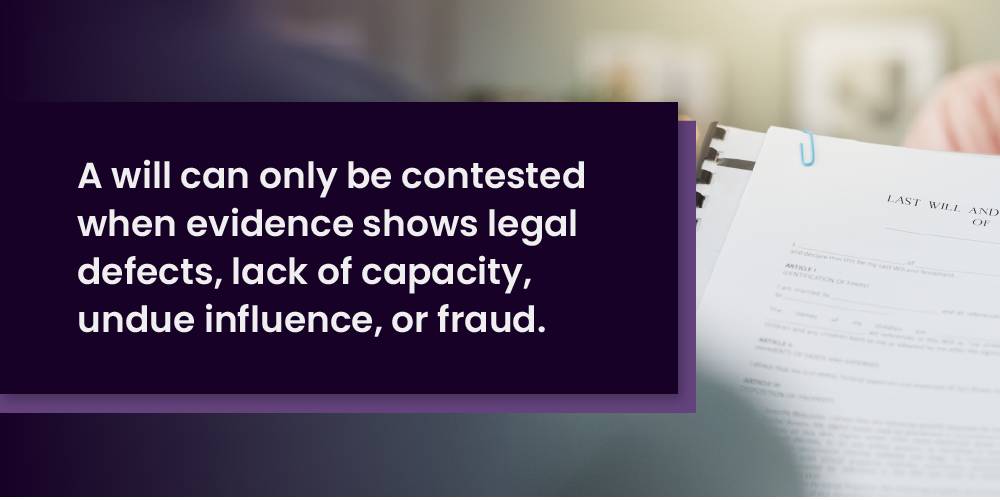
There are several situations in which you can file a challenge to your loved one’s will. To be successful in such a challenge, you will need to show that:
-
The will was not legally executed. Every state maintains its own laws regarding the signing and execution of a will. In Illinois for example, a will must be signed in the presence of two witnesses, neither of whom may be listed as a beneficiary.
-
Your loved one lacked the capacity to execute a will. If the decedent was lacking in mental faculties and unable to make sound decisions, any will he or she signed could be subject to legal challenges. According to the National Institute on Aging, one in three people 85 and older lives with Alzheimer’s, which can raise questions about wills drawn up later in life.
-
There was undue influence on your loved one. Did someone else coerce or pressure the person into making changes to the will? While proving undue influence is difficult, if another party manipulated your loved one into signing a will, it may be set aside.
-
The will was signed through fraud. If your loved one signed a will prepared by another person, but believed it to be a different document – a power of attorney, for example – the will can be deemed to have been procured by fraud. Proving fraud is challenging and may rely on the testimony of the witnesses to the signing.
How Do You Prove Undue Influence in a Will?
Undue influence is one of the most common reasons people challenge a will in Illinois. The key issue in these cases is whether the will truly reflects the testator’s wishes or someone else’s agenda.
To prove undue influence, you must show more than persuasion. Illinois courts look for proof that there was pressure strong enough to override the testator’s free will. Judges often consider whether the person accused of influence had a trusted or controlling relationship with the testator. This could be a caregiver, family member, or close advisor. Courts also look at timing. Sudden changes near the end of someone’s life can raise concerns, especially if the testator was isolated, ill, or dependent on others.
Evidence may include medical records, witness testimony, financial documents, and past versions of the will. If one person gained a large or unexpected benefit, that can support the claim.
Can You Remove the Executor of a Will in Illinois?
An executor can be removed in Illinois, but not just because someone is unhappy. Probate courts require good cause. An executor may be removed if he fails to perform required duties, mishandles estate funds, acts dishonestly, or cannot carry out the role due to illness or incapacity.
Interested parties can ask the court to intervene by filing a petition. The judge will review evidence and decide whether removal is necessary to protect the estate and its beneficiaries.
What Is the Process for Challenging a Will in Illinois?
The Illinois Probate Act sets strict timelines and procedures for contesting a will. Under 755 ILCS 5/8-1, you must file your will contest within six months of the will being admitted to probate. Missing this deadline usually means losing your right to challenge the will.
The process typically includes:
-
Filing a petition: You or your attorney must submit a written petition to the probate court outlining your reasons for contesting.
-
Serving notice: Other beneficiaries and interested parties must be formally notified.
-
Discovery and evidence gathering: Both sides exchange documents, take depositions, and gather evidence to support their case.
-
Court hearing or trial: A judge or jury hears arguments, reviews evidence, and decides whether the will is valid.
Contesting a will is often an emotionally-charged process because it involves family relationships and the wishes of a deceased loved one. Courts approach these cases with care but require strong evidence to overturn a will. That is why you need a seasoned attorney to help you build your case.
Contact a DuPage County Wills and Trusts Attorney
Challenging a will can be time-consuming and expensive, both in terms of money and in the relationships you have with other loved ones of the deceased. Before you make any decisions, speak to an experienced Lombard, IL estate administration attorney so that you fully understand the implications. Schedule a confidential consultation at A. Traub & Associates today and get the help you need. Call 630-426-0196 for an appointment.
Work with Our Team
& Get Started Today
To get in contact with a member of our team, call or text us at 630-426-0196
or fill out and submit the contact form below.
 The use of the Internet or this form for communication with the firm or any individual member of the firm does not establish an attorney-client relationship. Confidential or time-sensitive information should not be sent through this form.
I have read and understand the Disclaimer and Privacy Policy.
Lombard
200 W. 22nd Street, Suite 210
Lombard, IL 60148
P 630-426-0196
MAP + DIRECTIONS
Arlington Heights
634 S. Arthur Avenue
Arlington Heights, IL 60005
P 847-749-4182
MAP + DIRECTIONS

LEAVE US A REVIEW
200 W. 22nd Street, Suite 210
Lombard, IL 60148






Apply Now!
Please submit your resume in PDF format via e-mail: hello@atclaw.com.
Your application should include your resume and a cover letter. Our team reviews all submissions from potential candidates, and we will respond to your email as quickly as possible. If you have any questions about the position or the submission of your resume, please send us an email using the link above.
