
CALL OR TEXT US NOW
630-426-0196

How Can I Get Full Custody in Illinois?
 The stakes are high when a parent seeks full custody. These decisions shape where a child lives, where they go to school, and who makes critical choices about their upbringing. Illinois law has moved away from traditional "custody" language, instead using "allocation of parental responsibilities" to determine parenting time and decision-making authority.
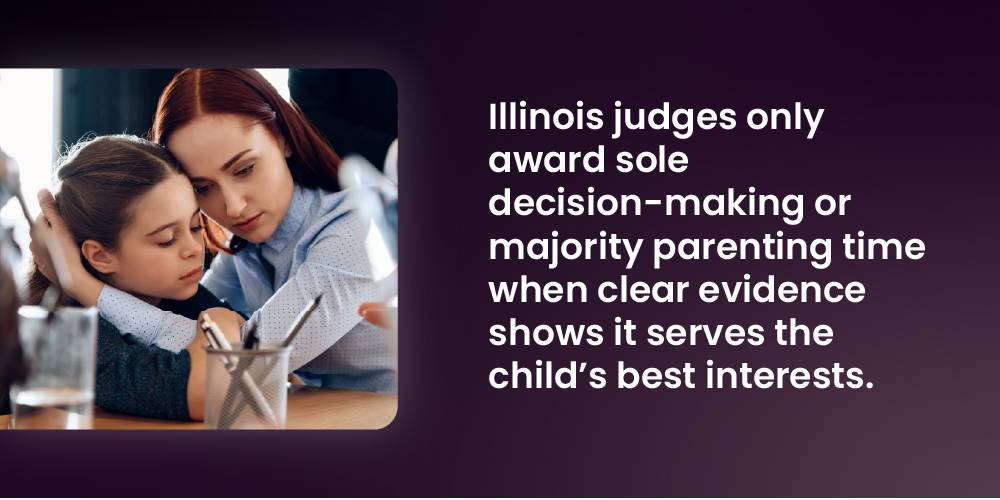
A judge will award one parent the majority of parenting time or sole decision-making power only when clear evidence proves this arrangement serves the child's best interests. DuPage County courts follow the framework established in the Illinois Marriage and Dissolution of Marriage Act when making these decisions. Given the complexity of these cases, you should turn to our DuPage County, IL parental responsibilities lawyers for guidance navigating the legal process.
What Does "Full Custody" Mean in Illinois?
While many parents still use the phrase "full custody," Illinois law breaks parental responsibilities into two distinct categories. Decision-making authority covers major choices about the child's medical care, education, religious upbringing, and extracurricular activities. Parenting time establishes the schedule determining when the child resides with each parent. In practice, "full custody" typically means one parent receives sole decision-making authority along with the majority of parenting time.
Under 750 ILCS 5/602.5 and 750 ILCS 5/602.7, judges must prioritize the child's best interests above all else. Courts evaluate each parent's living situation, work schedule, history of involvement in the child's life, and ability to meet the child's physical and emotional needs. Illinois law rejects any presumption that equal parenting time serves children best. Instead, judges examine the specific circumstances of each family before making a determination.
What Evidence Helps a Parent Seek Full Custody?
Judges want to understand the child’s daily life and which parent provides stability. They also look at long-term behavior, not just one argument or a short conflict. Useful evidence may include:
-
Statements or records from teachers
-
Medical records or input from doctors
-
Notes or reports from counselors or therapists
-
Statements from other adults who know the child well
-
Text messages or written communication between parents
-
Parenting schedules and records demonstrating past routines
Courts value evidence that shows consistency over time. Clear, organized records help the judge see patterns that may not be obvious from testimony alone.
Can a Judge Limit the Other Parent’s Parenting Time?
A judge may limit parenting time when a child's safety is at risk. These limits do not end the parent-child relationship. They add protection. When a parent can’t provide consistent, safe care, the court may order supervised visits at special centers in counties like DuPage or Kane. Staff members watch all interactions during these visits.
Courts can also control where visits happen, how long they last, and how often they occur. A parent may need to finish counseling or treatment before anything changes. The judge checks on the parent's progress and decides if the parenting plan should be updated. Illinois courts try to keep children safe while letting both parents stay involved whenever possible.
How Do You Start the Process of Requesting Full Custody?
To start a full custody request, you must file a petition in the circuit court where your child lives. Many Illinois courts require mediation before a trial. This is a meeting with a trained neutral person who helps parents try to reach an agreement. If parents do agree, the judge still checks the plan to make sure it follows Illinois law.
If mediation does not work, each parent submits a proposed parenting plan. These plans explain schedules, decision-making, communication, and how transportation will work. The court may also appoint a guardian ad litem or child representative. These are trained professionals who investigate the case. They talk to parents, teachers, doctors, and sometimes the child.
If circumstances later change, parents can ask for a new order under 750 ILCS 5/610.5. This may happen when a parent moves, develops a medical condition, or fails to follow the current order.
How Do Illinois Judges Decide What Is in a Child’s Best Interests?
Judges follow the best-interest factors in the Illinois Marriage and Dissolution of Marriage Act. These factors help them understand what will meet the child’s needs. They study how each parent supports the child’s emotional health, school life, and daily routine.
Some specific factors they will consider include:
-
The child’s relationship with each parent
-
How well the child adjusts to home, school, and community
-
Each parent’s past caregiving
-
Whether each parent supports the child’s relationship with the other parent
-
The mental and physical health of the parents
-
Any history of harmful behavior
A child may share their wishes if they are old enough to understand the situation. Their opinion does not decide the case, but it can be a factor. Judges may also ask for evaluations from psychologists or counselors. Every factor helps the judge decide what parenting plan gives the child the most support.
Do Custody Cases Work Differently Depending on Where You Live in Illinois?
DuPage County follows Illinois state law but has its own local procedures that affect how cases move through the court system. The county may require parents to complete a parenting class early in the case to help them understand how their decisions affect their children and what the court expects during the legal process.
DuPage County courts also have access to local resources like supervised visitation centers and trained mediators. The county's procedures can affect how quickly your case moves forward and what services you'll need to use. Understanding these local requirements from the start helps you prepare properly and avoid unnecessary delays.
Talk to a Wheaton, IL Child Custody Attorney Today
If you need guidance on requesting full custody or understanding how Illinois parenting laws apply to your situation, contact A. Traub & Associates at 630-426-0196 today. We are a female-owned and led law firm, and our attorneys are certified mediators who understand how to guide parents through difficult disputes while keeping children's best interests at the center. Families trust our DuPage County, IL parental responsibilities lawyers to navigate the complexities of parental responsibility cases and protect what matters most.
Work with Our Team
& Get Started Today
To get in contact with a member of our team, call or text us at 630-426-0196
or fill out and submit the contact form below.
 The use of the Internet or this form for communication with the firm or any individual member of the firm does not establish an attorney-client relationship. Confidential or time-sensitive information should not be sent through this form.
I have read and understand the Disclaimer and Privacy Policy.
Lombard
200 W. 22nd Street, Suite 210
Lombard, IL 60148
P 630-426-0196
MAP + DIRECTIONS
Arlington Heights
634 S. Arthur Avenue
Arlington Heights, IL 60005
P 847-749-4182
MAP + DIRECTIONS

LEAVE US A REVIEW
200 W. 22nd Street, Suite 210
Lombard, IL 60148






Apply Now!
Please submit your resume in PDF format via e-mail: hello@atclaw.com.
Your application should include your resume and a cover letter. Our team reviews all submissions from potential candidates, and we will respond to your email as quickly as possible. If you have any questions about the position or the submission of your resume, please send us an email using the link above.
